
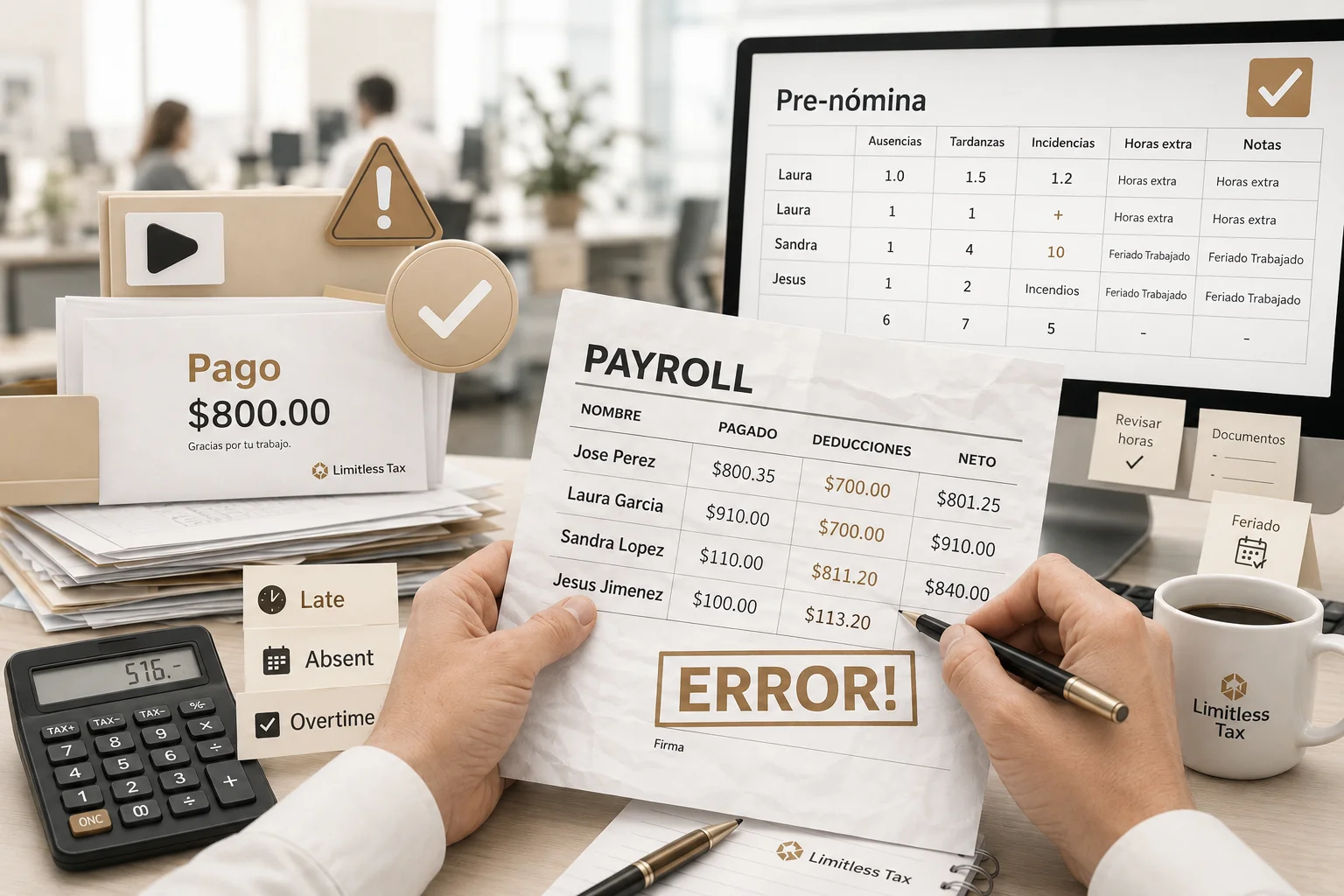
Payroll Errors in Florida: A Guide for Business Owners Who Want to Avoid IRS Penalties
Do you have employees in Miami or Hialeah? 40% of small businesses pay unnecessary IRS penalties due to payroll mistakes. Discover the 4 most common errors, what they cost, and how to avoid them. Limitless Tax breaks it down.
Having employees is one of the most important milestones in growing a business. It’s also one that comes with significant tax responsibilities. And here’s the number that surprises most business owners when they hear it:
⚠️ 40% of small businesses in the U.S. pay an average of $845 per year in IRS penalties due to payroll mistakes. Most of those errors were completely avoidable.
These aren’t careless businesses. They’re busy owners — running restaurants, salons, construction companies, cleaning services — managing their own payroll without knowing exactly what the IRS requires. In this article, we walk you through the 4 most common payroll mistakes, what they can cost, and what to do to avoid them.
Mistake #1 Depositing Payroll Taxes Late
When you pay your employees, you don’t just owe them their wages. You’re also required to withhold and deposit taxes with the IRS from every paycheck: federal income tax, Social Security, and Medicare. That money isn’t yours — it belongs to the government, and you’re holding it in trust. The IRS sets specific deadlines for those deposits. If you miss them, penalties begin accruing from day one.
| Days Late | Penalty Applied | On a $5,000 Deposit |
|---|---|---|
| 1 – 5 days | 2% of total | $100 |
| 6 – 15 days | 5% of total | $250 |
| More than 15 days | 10% of total | $500 |
| 10+ days after IRS notice | 15%of total | $750 |
📌 Real example: A landscaping company in Hialeah with 6 employees deposited payroll taxes one week late for four consecutive months. Result: over $800 in penalties — plus interest.
The fix? Set up an automatic deposit calendar and confirm your schedule: monthly or semi-weekly, depending on your prior-year payroll tax liability.
Mistake #2 Misclassifying Workers: Employee vs. Independent Contractor
This is one of the most expensive — and most common — payroll mistakes, especially in construction, cleaning, and beauty services. Many business owners call their workers “independent contractors” when the IRS actually considers them employees. The distinction matters enormously:
- An employee: you must withhold taxes, pay your share of Social Security and Medicare, and issue a W-2 at year end.
- An independent contractor (1099): you don’t withhold taxes — you only report payments of $600 or more per year.
⚠️ If the IRS determines you misclassified a worker, it can charge you for all unpaid taxes from prior years — plus interest and penalties — even if that worker is long gone.
The IRS uses a behavioral control test: do you control how and when the person works, or just the final result? If you control the process, they’re likely an employee.
Mistake #3 Failing to Separately Report Overtime Compensation in 2026
🆕 New in 2026: The IRS announced that starting this tax year, employers must separately report qualified overtime compensation on applicable tax forms. This requirement affects any business with hourly employees.
Previously, overtime pay was simply included in total wages reported. Now it must be identified separately — which affects payroll systems, W-2 forms, and year-end processing.
Who feels this most? Businesses with hourly workers: restaurants, hotels, healthcare services, construction, and manufacturing. If you have employees who regularly work more than 40 hours per week, this change applies directly to you.
Businesses that still process payroll manually or with outdated software are the most vulnerable — because their systems simply aren’t configured to separate that information.
💡 Immediate action required: Verify with your payroll provider or accountant that your system is already updated to comply with this new requirement. If it isn't, every W-2 you issue at year-end could be incomplete — triggering penalties.
Mistake #4 Not Keeping Clean Records to Support Your Payroll
The IRS doesn’t just check that you paid — it also checks that you have documentation to prove it. And when your books are disorganized, two things happen:
- You can’t respond accurately to an IRS notice
- You make calculation errors that compound month after month without realizing it
- You can’t identify whether you’re overpaying or underpaying payroll taxes
Bookkeeping and payroll go hand in hand. If your books aren’t current, your payroll can’t be accurately calculated either.
💡 A business with clean, monthly books can answer any IRS question with confidence. A business with messy records is already at a disadvantage before the letter even arrives.
Frequently Asked Questions About Payroll and IRS Penalties
-
How do I know if I’m a monthly or semi-weekly depositor?
It depends on your total payroll tax liability from the prior year. If you deposited less than $50,000 in employment taxes during the lookback period, you’re a monthly depositor. If you deposited $50,000 or more, you’re semi-weekly. The IRS notifies you each November for the following year.
-
Can I appeal an IRS penalty for a late payroll deposit?
Yes. If it’s your first error and you can demonstrate reasonable cause — not willful neglect — the IRS may waive the penalty. First-time infractions generally receive more leniency. That’s why acting quickly and having documentation matters so much.
-
What form do I use to report payroll taxes?
The primary form is Form 941, filed quarterly. Form 944 is available for businesses with annual payroll tax liability under $1,000. At year-end, you must issue a W-2 to each employee and file a W-3 summary with the IRS.
-
Do payroll rules apply even if I only have one employee?
Yes. The moment you have even one employee, all payroll obligations apply in full: tax withholding, deposits, quarterly returns, and a W-2 at year end. There’s no exemption based on business size.
-### Is it worth hiring an outside payroll service? For most small businesses in Miami, the answer is yes. The cost of professional payroll service is typically less than a single IRS penalty. And beyond avoiding errors, it frees up your time to focus on growing your business.
Payroll Isn’t Just About Paying Wages — It’s About Staying Compliant Every Pay Period
Payroll is one of those processes that, when it works well, nobody notices. But when something goes wrong, the impact is immediate: penalties, IRS notices, frustrated employees, and hours lost trying to correct mistakes. The good news is that every single one of these errors is preventable. With the right process, the right software, or the support of a trusted professional, you can manage your payroll with confidence — without living in fear of an IRS notice. At Limitless Tax, we’ve spent over 10 years helping businesses like yours in Hialeah, Miami, Homestead, and Charlotte manage payroll correctly — month after month, year after year.
Is your payroll actually in order? Let’s find out.
Our team can review your current payroll process, identify risks before they become penalties, and help you build a reliable system. 3,150+ clients trust Limitless Tax with their finances — your business deserves the same.